How Colour and Community Making Shaped Our Whitechapel Vision
Exploring how community-led making and applied colour psychology can create lasting social value long before construction begins.
Luc Jones, our Bristol Studio Lead, reflects on the practice’s shortlisted competition entry at Whitechapel Market, Tower Hamlets, and how the process of designing a place can create value long before construction begins.
We entered the New London Architecture’s Whitechapel Market Gateways Design Competition to explore some big ideas. After all, competitions are the perfect opportunity to push the boundaries of design, and to be bold and memorable.
But we had to ask ourselves: did Whitechapel and its busy market street really need another designer arriving with a big idea? If we were to bring something to the table, it would need to offer something different.
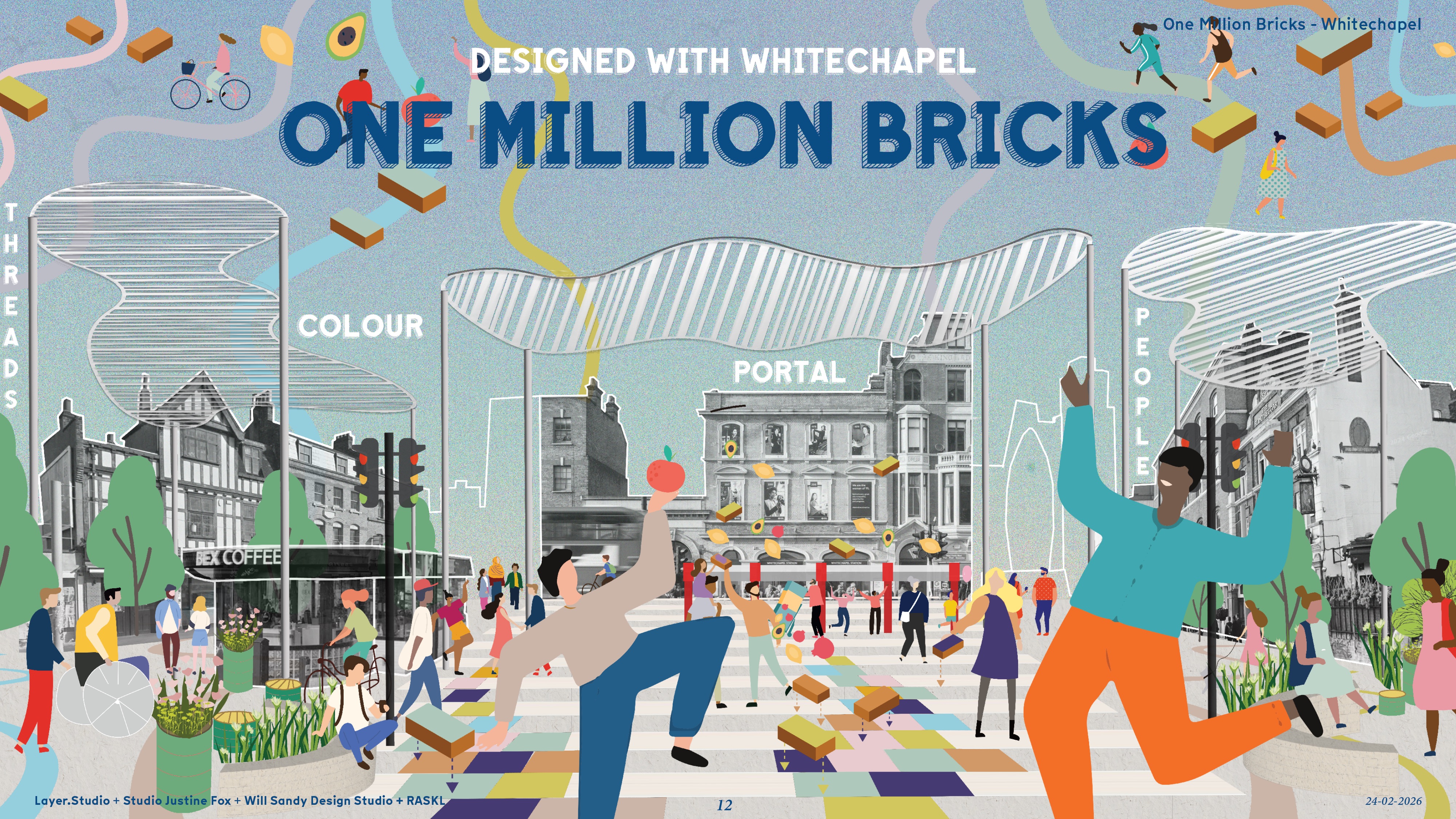
We saw the opportunity to use the project as a catalyst for something bigger; to create opportunities for community ownership, making, entrepreneurship and a legacy through social value.
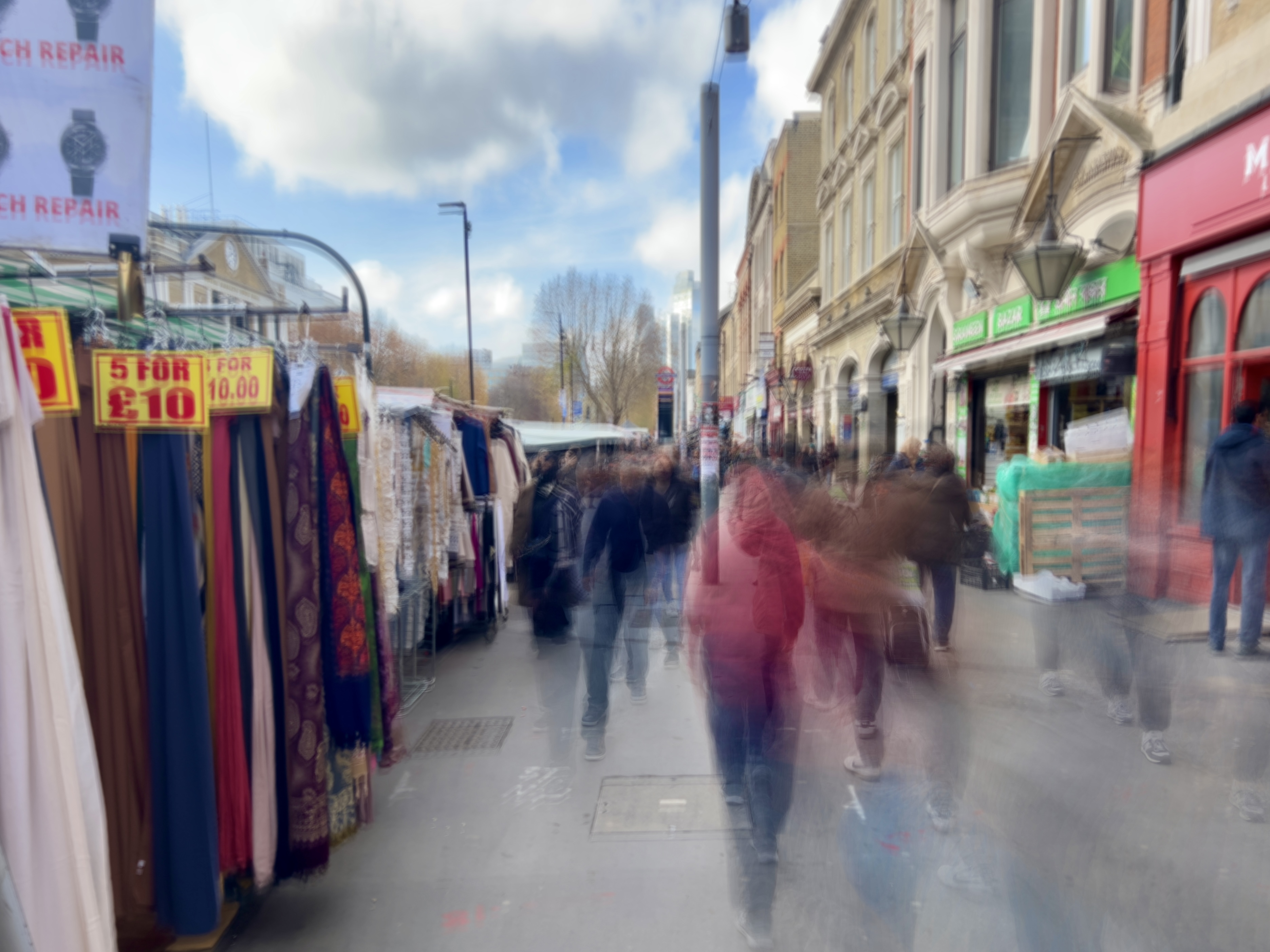
Whitechapel is a place of movement, exchange and constant reinvention. Generations of migration have created a tapestry of cultures, food, faith, languages and identities, held together by a strong sense of local pride. The market sits at its heart. It’s busy, sometimes chaotic and intensely human. More than “somewhere to shop”, it’s a piece of social infrastructure in its own right with plenty of stories to tell.
Jan Gehl’s principle of “First life, then spaces, then buildings” fits neatly with our own values and felt particularly relevant here. So, before asking what the gateway should look like, we focused on listening and understanding how people wanted their Whitechapel to feel. The design response would follow.
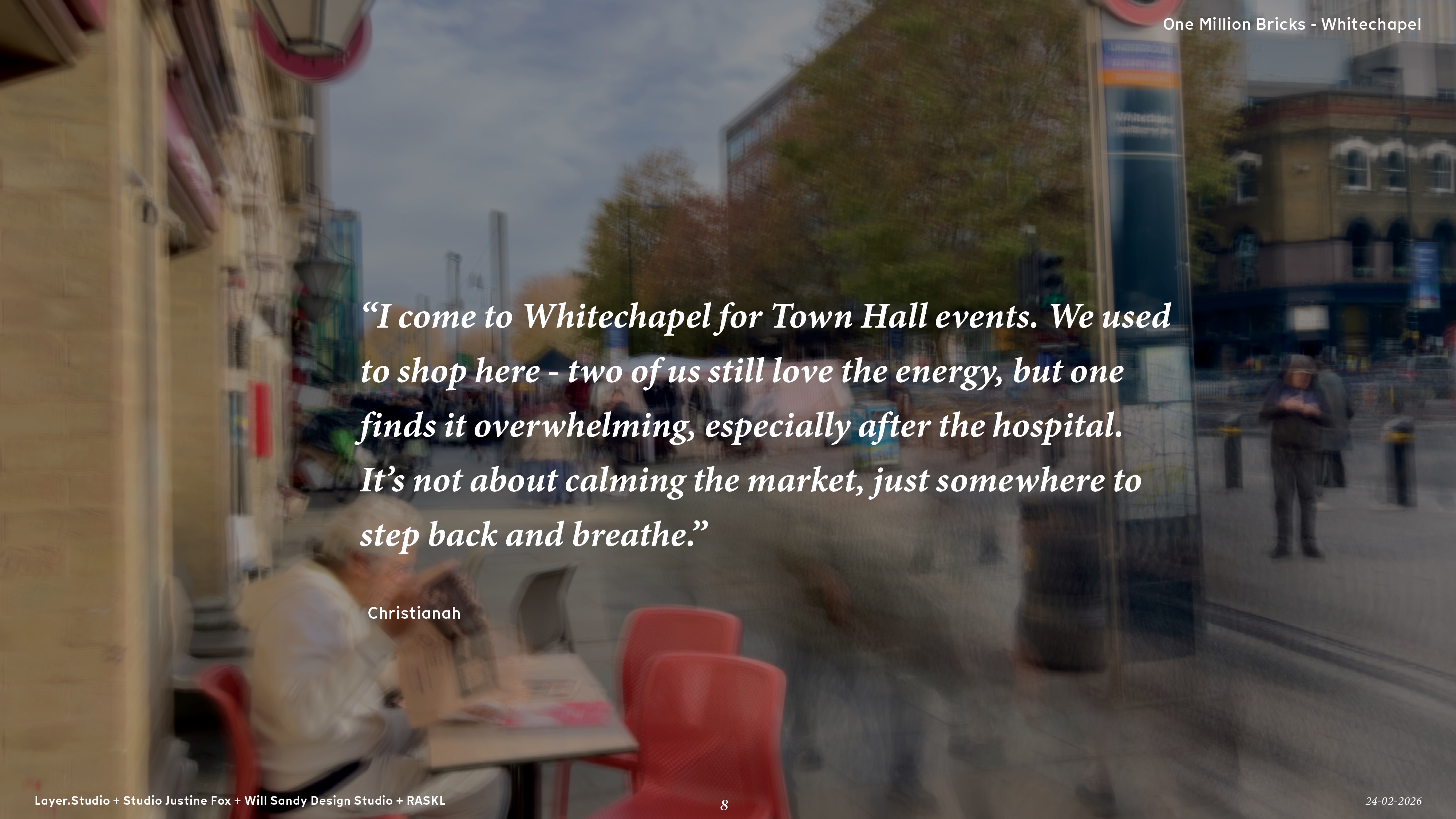
Mohammad, Buket, Fahimah and Christiannah were among many who shared their experiences of Whitechapel, from its vibrant market and strong sense of community to the need for more greenery and quieter spaces away from the bustle. These conversations, and countless others, helped shape our understanding of the place and what people wanted from it.
Colour is more than an aesthetic decision
One of the earliest conversations we had was around colour. Not what would look good on Whitechapel Road, but how colour could influence how people feel in the public realm.
To explore that properly, we worked with Justine Fox, founder of Studio Justine Fox, a specialist in applied colour psychology. Her input challenged us to think beyond the conventional use of colour as a finishing layer and consider its relationship with emotion, behaviour, culture, identity and wellbeing.
Justine explains:
“Although our individual experiences of colour differ, there is common ground in many of the emotional associations we make with it. It’s a conduit to sharing our feelings about the places in which we live and work.”
For Whitechapel, there was an opportunity to explore the human and emotional resonance of colour giving the Whitechapel community a distinct voice and identity.”
Her approach combines applied colour psychology with cultural understanding and emerging research around neuroaesthetics and lived neurodivergent experience.
Whitechapel Road is an intensely colourful place already, through food, textiles, shopfronts, signage, faith, fashion and the market itself. This richness provided a wonderful starting point for conversations with the community about their experiences of and aspirations for their high street.
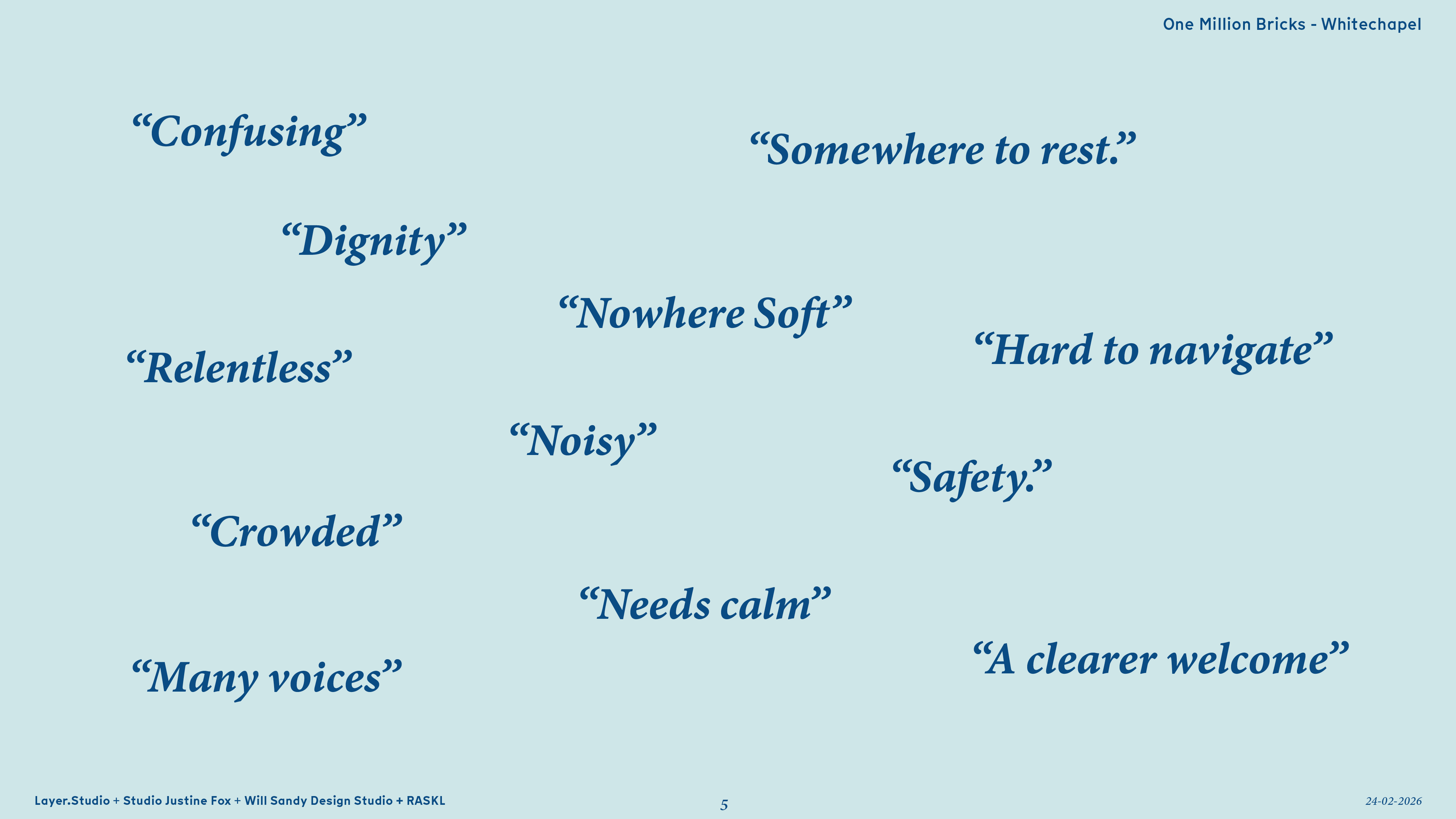
People wanted to feel welcome, calm, confident, inspired, focused and relaxed.
We explored hue, saturation, lightness and contrast as tools for creating rhythm, orientation, comfort and emotional response. These variables can alter how stimulating, legible and comfortable a place feels, and how intuitively people move through it.
Even better, colour is inherently accessible. You don’t need technical architectural language, an understanding in colour theory, or even fluency in English to be able to describe how colours make you feel. This was especially valuable in such an ethnically-diverse area, where Justine’s approach offered an opportunity to hear from voices that might otherwise be missed.
Through these conversations we could begin to develop a working palette, while considering the cultural associations and different sensory experiences that shape how people use the street.
Making as social infrastructure
Public engagement often asks people to respond to something that’s already been defined. The second of our big ideas explored a more practical proposition:
WHAT IF THE PROCESS OF MAKING THE PUBLIC REALM ITSELF BECAME PART OF THE ENGAGEMENT?
This idea evolved through our collaboration with Will Sandy Design Studio, whose thinking helped push the concept beyond material choice and towards something much more participatory. Rather than seeing fabrication as the final stage of design, we reframed it as a valuable social process.
Whitechapel gave us a particularly rich opportunity to explore this thinking. The area’s history of brickmaking, which helped shape Whitechapel’s employment landscape and attracted migrant communities, is reflected in the aptly named nearby Brick Lane. This heritage inspired our proposal for a community brickmaking programme.

We envisaged local people making bricks that could become part of the finished public realm. We proposed workshops involving local schools and community groups, with opportunities to collaborate with local makers, kilns and contractors.
As vehicles for individual expression, individual bricks could vary in pigment, material and texture, carrying the marks of their maker while retaining common dimensions. Each would be unique, yet part of a collective whole. It’s a form of engagement that leaves something tangible behind, building attachment, pride and stewardship.
For us, this is where making becomes social infrastructure. Community manufacturing can build relationships and sharpen skills. It can create opportunities for training and apprenticeships, local enterprise, artist commissions and longer-term partnerships. All while bringing people together to contribute to the finished public realm.
Of course, this concept can extend well beyond bricks. Our profession deals with an abundance of physical things, from paving and planting to furniture, structures and materials. Each represents an opportunity to involve the community that will inherit it.
Making can turn engagement from something observational into something active. It can create skills as well as objects, and relationships as well as spaces.
A gateway designed by Whitechapel
We wanted our final proposition to be a catalyst for conversations, skills, ownership and pride. It needed to respond to the neighbourhood’s layered mix of cultures and busy market life, while addressing the challenges of an already crowded street. By exploring colour and making, we would then be able to design gateways that reflected Whitechapel’s identity, and that the community could recognise as their own.
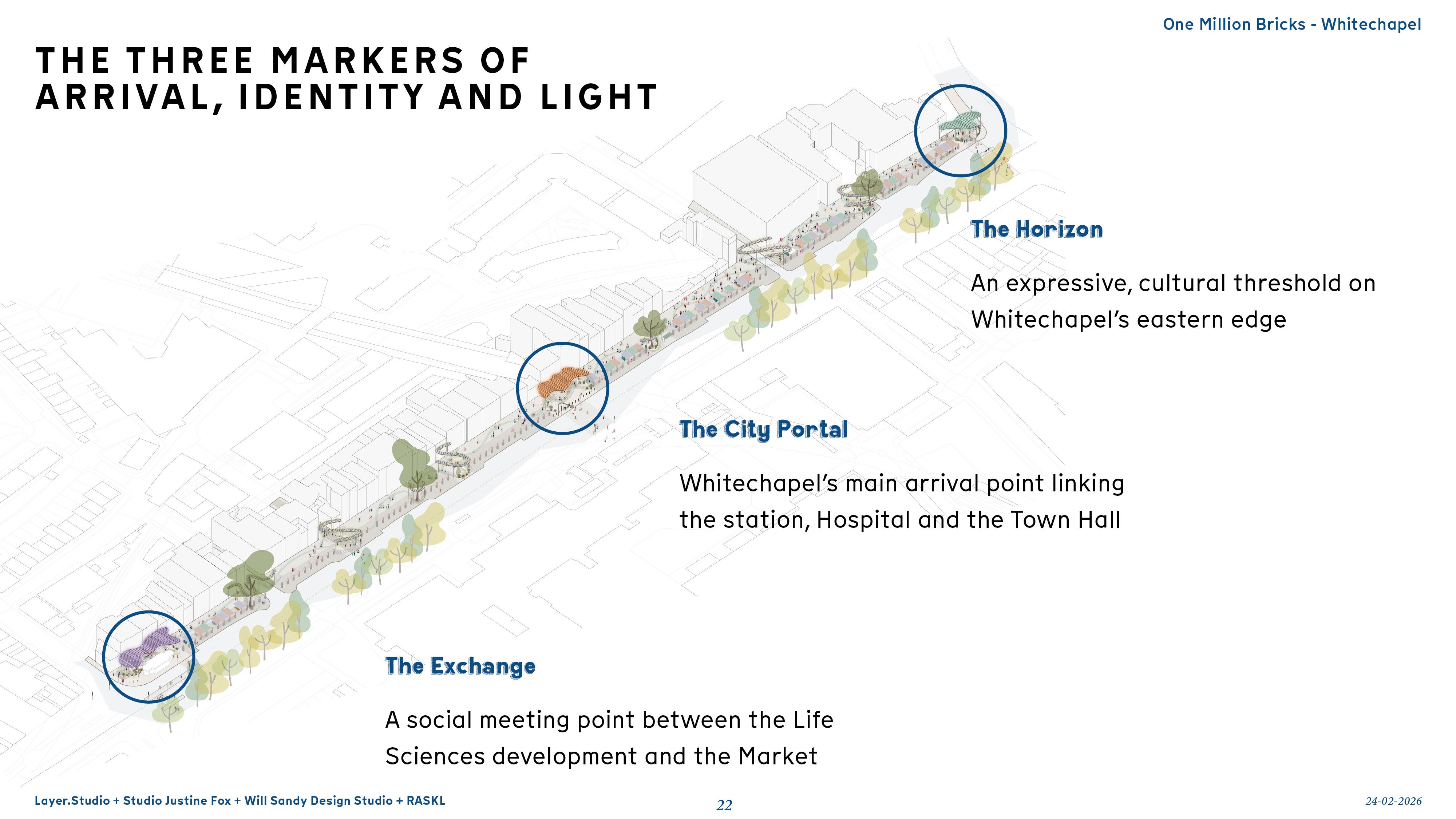
Our response focused on three points of arrival, exchange and belonging:
- A portal to the world: centred on Whitechapel Station, where the Lizzy Line connects to the city, the airport and thus… the world.
- A portal to the city: at the western end of the market, looking west towards the City of London skyline
- A portal to the community: at the eastern end of the street connecting the market with the surrounding residential neighbourhoods
Between each of these, small interventions marked other important connections towards schools, shops, the hospital and community facilities. A continuous thread of community-made brick paving connected the gateways, with brickwork intensifying at the key arrival gateways.
The idea for the brick-making space itself was just as important as the gateways themselves: the workshop would be a place for encounter, skill-sharing and collective production, potentially extending into schools, community groups and temporary spaces across the neighbourhood.
One of the challenges was that Whitechapel Road was already a busy, cluttered environment, with limited space for additional structures. We wanted our gateways to create a sense of arrival without making the street harder to navigate. Our response was to keep the physical interventions relatively simple, using colour, lighting and surface treatments to give each gateway its identity while maintaining clear routes through the market. We used reflective finishes to reflect the paving and activity below, visually connecting the ground plane with the structures above, and integrated lighting so the gateways could change in appearance after dark.

Reflecting and reinforcing, but never overriding
The intention was never to give Whitechapel an identity. It already has one. Our role was to create gateways capable of recognising, connecting and celebrating it.
Our experience at Whitechapel reinforced something important for us at Layer.studio. Meaningful engagement has a fundamental role to play in shaping the character, relevance and longevity of the places we create. It should never be merely an additional design stage.
The competition also challenged us to think more broadly about the value of the design process itself. What if delivering the process of a new public space could create opportunities for people to learn skills, build relationships and contribute something of their own? And what if those benefits began to emerge long before construction?
Britain has a rich history of making and manufacturing. Those traditions helped shape the identity of places like Whitechapel providing livelihoods and skills, and strengthening communities. Yet opportunities for people to participate in the physical creation of their surroundings is increasingly rare.
Perhaps there’s something to be gained from reconnecting with that tradition. Our Whitechapel collaboration has given us ideas and approaches that we'll carry into future projects and reinforced our belief that involving people in the creation of their surroundings is just as valuable as asking them what they want from the finished result.
Ultimately, the opportunity for landscape architects is to think beyond the end result and consider what the process of creating it can leave behind.